
OGEMID Seminar programme
Introduction
Initiated by Tony Cole, Senior Lecturer Brunel Law School at the time, the goal of these (mini-)seminars is to spur close analysis and vigorous discussion of current and recent cases. Four to five invited panelists, from both practice and academia, are invited to post short (500-1000 words) analyses over the course of a few days, generating useful comments and feedback from OGEMID members.
If you have any suggestions for topics or an OGEMID seminar feel free to contact us. You can learn more about OGEMID here.
Newest first:
OGEMID Symposium Art & Arbitration (12-19 June 2026)
Conflicts involving art, antiquities and cultural heritage are as ubiquitous and unique as the works they concern. Of these conflicts, "repatriation is perhaps the most intractable and contentious part of the bitter art wars." Characterized by traditional legal complexities surrounding matters such as provenance, authenticity, and restitution, repatriation disputes also present distinct cultural and ethical dimensions rooted in historical responsibility, identity and memory as well as the practical challenges of addressing losses that occurred long ago often spanning multiple jurisdictions. Considering these distinct features, stakeholders increasingly have moved away from traditional court litigation to alternative dispute resolution (ADR) with its creative approaches offering confidentiality, flexibility, and the ability to appoint arbitrators with specialized expertise. In this symposium, we address the multi-faceted matter of art, antiquities and heritage arbitration in a world where the international rules-based order is increasingly challenged. We dive into the procedural complexities and substantive quirks that characterize such arbitration, which seeks to settle disputes forged both in times of peace and war.
Moderators and Panelists
- Professor Petra Butler; University of Canterbury
- Mohit Dang; Argus Partners (Solicitors & Advocates)
- Dr. Shea Esterling; University of Canterbury
- Wendell Leal Hossu Monteiro de Melo; Justen, Pereira, Oliveira & Talamini
- Tetiana Bersheda; Bersheda Law (Independent arbitrator and legal counsel)
More about OGEMID and Registration here www.transnational-dispute-management.com/ogemid (trial memberships available).
Table of Contents and free excerpts:
- TDM 2 (2014) - The New Frontiers of Cultural Law: Intangible Heritage Disputes
- TDM 5 (2013) - Art and Heritage Disputes in International and Comparative Law
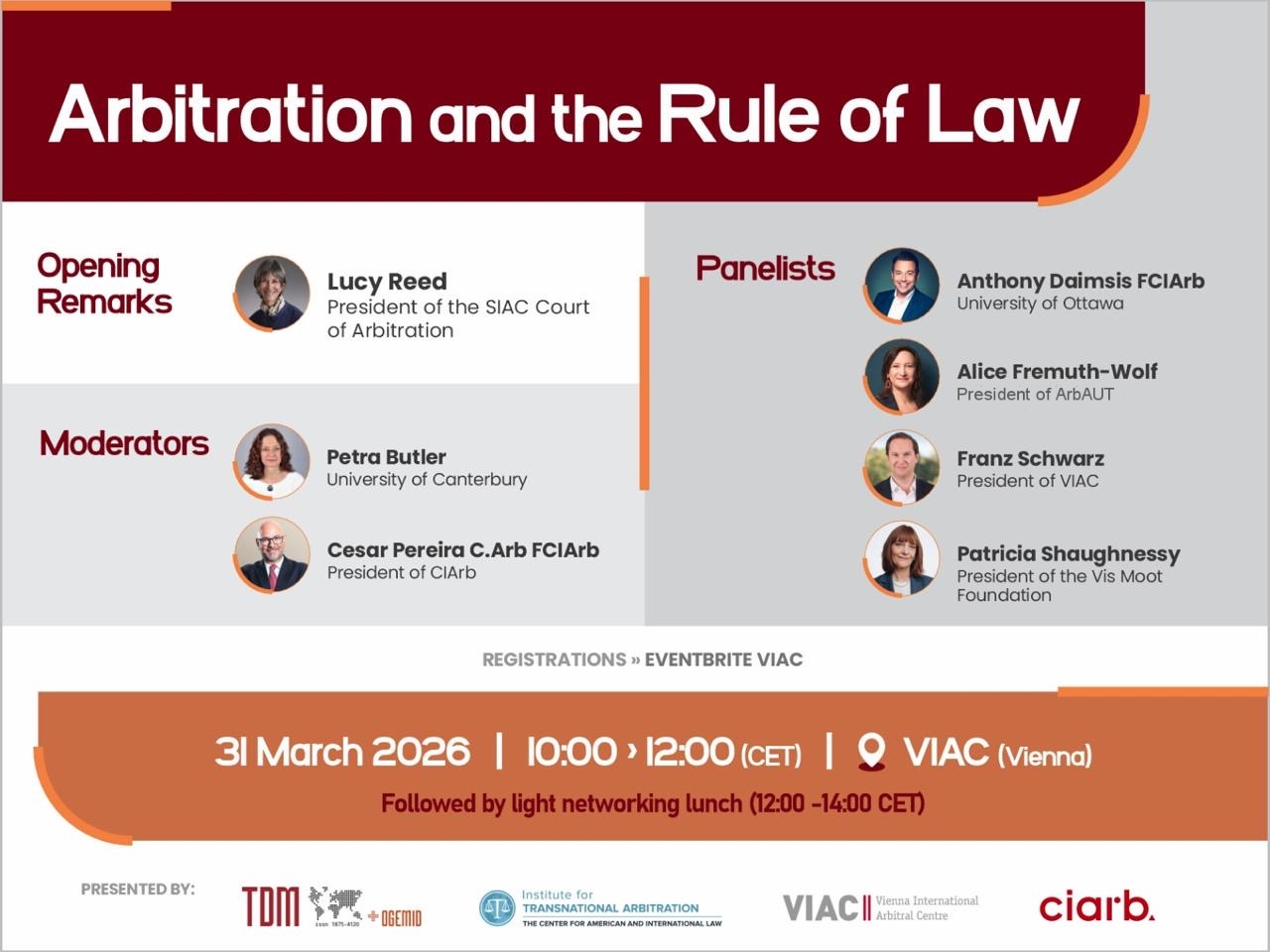
Arbitration and the Rule of Law (Vienna, Austria)
Arbitration and the Rule of Law
Wien, Austria
31 March 2026 (10 am to 2 pm)
Flyer: www.transnational-dispute-management.com/news/20260331.pdf
Join us during the 33rd Vis Moot for an intriguing panel discussion on Arbitration and the Rule of Law.
The session will feature a opening remarks by Lucy Reed, President of the SIAC Court of Arbitration, followed by a distinguished panel of leading academics and practitioners featuring: Anthony Daimsis FCIArb (University of Ottawa), Alice Fremuth-Wolf (President of ArbAUT), Franz Schwarz (President of VIAC), and Patricia Shaughnessy (President of the Vis Moot Foundation).
The discussion will be moderated by Petra Butler (University of Canterbury) and Cesar Pereira C.Arb FCIArb (President of CIArb).
Whether you're new to the topic or a pro, this event is a great chance to connect. Don't miss out on this great opportunity for networking and discussions!
Organised by: Transnational Dispute Management (TDM)/OGEMID - Institute for Transnational Arbitration (ITA) - Vienna International Arbitral Centre (VIAC) - Chartered Institute of Arbitrators (CIArb).
🗞 Rule of Law and Arbitration, Vienna, March 2026. A timely reminder how important thoughtful dialogue, principled debate, and a shared commitment to strengthening arbitration as a cornerstone of the international legal order is.
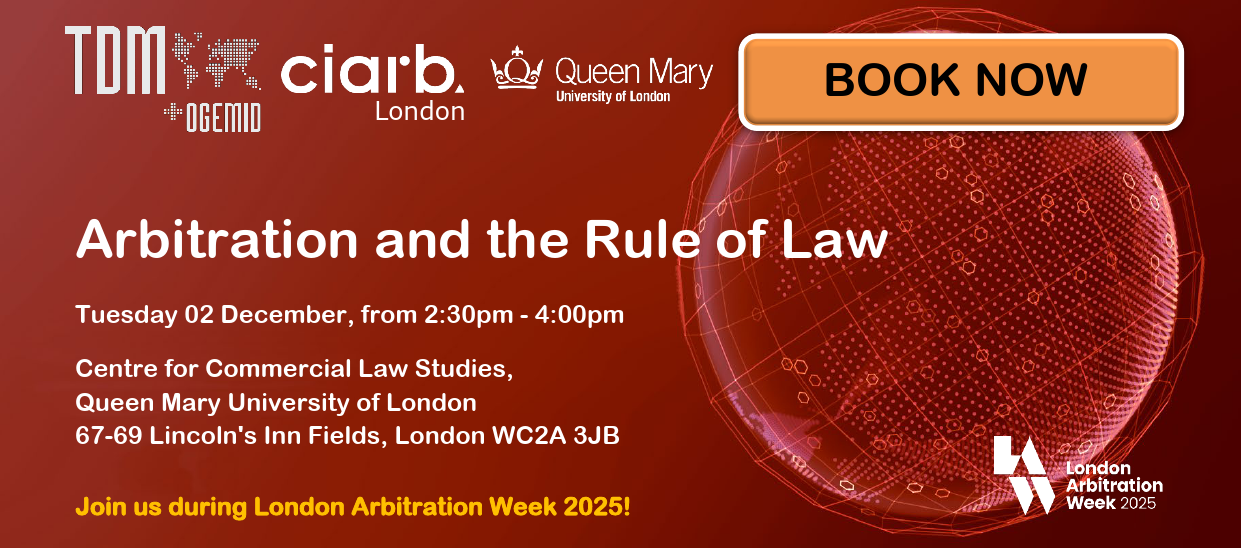
Arbitration and the Rule of Law (London, UK)
Arbitration and the Rule of Law
Tuesday 02 December from 2:30pm - 4:00pm
Centre for Commercial Law Studies,
Queen Mary University of London
67-69 Lincoln's Inn Fields, London WC2A 3JB
Join us during London Arbitration Week 2025!
Book now: londonarbitrationweek.co.uk/events/details/arbitration-and-the-rule-of-law
Flyer: www.transnational-dispute-management.com/news/2025-12-02-TDM-OGEMID-QMUL.pdf
Trust and Arbitration,
(Sept/Oct 2025)
Chair:
- Petra Butler, Victoria University of Wellington
Panelists:
- Andrew Butler, Thorndon Chambers
- Prof. S.I. Strong, Emory University School of Law
- Anna Kirk, Barrister; Arbitrator, Bankside Chambers
- And others to be confirmed...
More about OGEMID and Registration here www.transnational-dispute-management.com/ogemid (trial memberships available)
AfCFTA - Dispute Resolution Symposium,
(April/May 2025)
The OGEMID AfCFTA Symposium is a four-panel event designed to explore the intersections between the African Continental Free Trade Area and evolving frameworks for regional and international dispute resolution. The symposium will bring together leading scholars, practitioners, and commentators to reflect on AfCFTA’s broader implications for trade, investment, and legal integration across the continent.
Moderators: Cesar Pereira and Funke Adekoya, SAN.
- Panel 1: Beyond Trade - AfCFTA as a Driver for Regional Dispute Resolution (Scheduled Date: April 28, 2025)
This opening panel will explore how the AfCFTA serves as more than a trade agreement, positioning itself as a transformative mechanism for regional dispute resolution. - Panel 2: AfCFTA and ISDS - A Shift in Africa’s Investment Protection Framework (Scheduled Date: April 30, 2025)
Panel two will examine the AfCFTA’s impact on investor-state dispute settlement (ISDS) and its role in reshaping Africa’s investment protection architecture. - Panel 3: Navigating Overlaps - AfCFTA, African BITs, and the WTO System (Scheduled Date: May 6, 2025)
This panel will address the complexities and potential conflicts arising from overlaps between the AfCFTA, African bilateral investment treaties (BITs), and the multilateral WTO system. - Panel 4: Balancing State Sovereignty and Investor Protection under AfCFTA (Scheduled Date: May 8, 2025)
The final panel will focus on reconciling state sovereignty with investor protections within the AfCFTA regime.
Confirmed Panelists:
- Esine Okudzeto, Sam Okudzeto & Associates
- Jacqueline Waihenya, JWM LAW LLP
- Dr. Abayomi Okubote, Algoma University; Pensbury Attorneys & Solicitors
- Leonardo F. Souza-McMurtrie, University of Cambridge, Gates Cambridge Scholar
- Prof. Sope Williams, Stellenbosch University
- Dr. Kabir Duggal, Columbia Law School; Arnold and Porter
- Prof. Githu Muigai, University of Nairob; Mohammed Muigai LLP
- Riccardo Torre
- Jacqueline Waihenya
- Paula Kilusi
- And others to be confirmed...
- Stages of public procurement
- Luisa Quintao - Multiple approaches to arbitration in the contractual stage of public procurement: from prohibition to mandatory arbitration
- Nicholas Jobidon - Tender (pre-award) stage: can (and should) bidding disputes be arbitrated?
Beyond arbitration: thoughts on the role of mediation and other forms of ADR in public procurement
- Bhavana Sunder - The recent shift towards mediation in India
- Nicola Khoury - Should State agencies be mediators: the success story of Brazil’s TCU (Federal Court of Audit)
- What makes up a successful legal framework for arbitration in public procurement? (Part I)
- Funke Adekoya SAN: How to balance confidentiality, privacy, and transparency?
- Maite Quiñones: What is the appropriate level of regulation and intervention to ensure accountability?
- What makes up a successful legal framework for arbitration in public procurement? (Part II)
- Leonardo F. Souza-McMurtrie - What can commercial arbitration offer States and private suppliers to preserve government powers without sacrificing legal protection to suppliers?
- Christopher Yukins - (Lack of) arbitration in public procurement in the US: when do negotiation and administrative dispute resolution override the potential benefits of arbitration?
- Future developments
- Geo Quinot - In a context of multiple stakeholders, is a contract still the appropriate fundamental legal structure for public procurement? What are the potential dispute resolution consequences of a new, non-contractual approach to how governments procure goods, works or services?
- Astghik Solomonyan - International public procurement regulation: is arbitration in government contracts compliant with States’ obligations under the WTO/GPA (Agreement on Government Procurement)?
- Dmitri Evseev, Arbitrator
- Duncan Pickard, Debevoise & Plimpton LLP
- Dr. Olivia Erdélyi, University of Canterbury
- Petra Butler, Victoria University of Wellington
- Rina See, Bankside Chambers
- Cesar Augusto Guimarães Pereira, Justen, Pereira, Oliveira & Talamini
- Martin Kenney, MK Solicitors LP
- Funke Adekoya, SAN, Independent Arbitrator
- Sébastien Manciaux, University of Bourgogne, CREDIMI
- management of corruption allegation/suspicions by arbitral tribunals: should the arbitrators be proactive?
- annulment, recognition & enforcement of arbitral awards suspected to give effects to a corruption contract (or to a contract concluded through bribes): how state courts should proceed?
- corruption of the arbitral tribunal
- asset recovery
- matters of evidence
- and more...
- Dr Lucas Clover Alcolea, Lecturer, Faculty of Law, University of Otago
- Theominique Nottage, MCIArb, Counsel and Attorney-at-Law
- Anna Kirk, Barrister, Arbitrator, Bankside Chambers
- Keynote remarks by Philippe Pinsolle, co-chair of the IBA Task Force.
- Moderators: Barry Leon and Dr. Eva Litina
- Mark Kantor (Arbitrator)
- Rory Walck (Global Financial Analytics LLC)
- Kathleen Paisley (Ambos NBGO)
- Funke Adekoya (AELEX)
- The Impact of the Lack of Best Practice International Commercial Arbitration Framework
- Familiarity and Expertise in Arbitration within the Legal Profession
- SMEs - the "forgotten" Consumers of International Arbitration
- The Commonwealth Study in Review
- Petra Butler (New Zealand, Member Expert Group of the Study)
- Dharshini Prasad (UK, Secretary-General to the Study)
- Tochukwu Anaenugwu (Nigeria)
- Funke Adekoya (Nigeria)
- Philippa Charles (UK)
- James Clanchy (UK)
- Tony Cole (UK)
- Calvin Hamilton (Barbados)
- Barry Leon (British Virgin Islands, Canada & UK)
- Matthew Moorhead (UK)
- Nania Owusu-Ankomah (Ghana)
- Mahesh Rai (Singapore)
- Ana Tuiketei (Fiji)
- Arbitration study urges countries not to lose foreign investment and trade - Press release, 18 August 2020
- A Study of International Commercial Arbitration in the Commonwealth - PDF, 663 pages, 9.5mb
- Professor Yarik Kryvoi, BIICL
- Manjiao Chi Cliff, Law School, Xiamen University
- Dr. Kristen E. Boon, Seton Hall Law School
- Professor Makane Moïse Mbengue, Faculty of Law, University of Geneva
- What exactly is AI, and how is it currently relevant to the practice of law and arbitration?
- What is AI's growth potential in IA -- and how soon will its effects be even more widely felt?
- Will AI provide correctives for some of the well-documented human biases in the decision-making process; or
- Does machine learning, by contrast, run the risk of "baking in" and/or exacerbating systemic social biases?
- What, if anything, should all arbitration practitioners (and all lawyers) know about coding and machine learning?
- How substantial and realistic is the prospect of mass redundancy in an AI-dominated future?
- Remedies: Rukia Baruti (AILA)
- Compensation Standards: Alejando López Ortiz (Mayer Brown)
- Valuation Methodology: "Hot tubbing" of two experts, looking at preferences by claimants and respondents respectively. James Searby (FTI) (Respondent positions), and Daniel Flores (EconOne) (Claimant positions)
- Outlier claims: Irmgar Marboe (University of Vienna)
- Bilateral Investment Treaties and Foreign Direct Investment (October 2013);
Panel: Jason Yackee (University of Wisconsin Law School); Andrew Kerner (University of Michigan); Clint Peinhardt (University of Texas at Dallas); Bruce Blonigen (University of Oregon; National Bureau of Economic Research); Josh Kallmer (Crowell & Moring); Omar GarcÃa-BolÃvar (BG Consulting Inc.); Deborah Burand (University of Michigan Law School); Ana Gerdau de Borja (Wald Associados Advogados).
- Investment Arbitration Claims and State Policy Freedom (March 2014).
Panel: Tecle Hagos Bahta (University of Mekelle, Ethiopia; University of Botswana); Jonathan Bonnitcha (Lawyer, Visiting Fellow Australian National University); Mariel Dimsey (Cleary Gottlieb); Gustavo Fernandes (Tauil & Chequer Advogados); Lisa Sachs (Vale Columbia Center on Sustainable International Investment); Lise Johnson (Vale Columbia Center on Sustainable International Investment); Mark Kantor (international arbitrator); Dr. Lauge Poulsen (Nuffield College, University of Oxford); Stephan Schill (Max Planck Institute for Comparative Public Law and International Law).
- The evidentiary burdens and standards of proof surrounding corruption
- The duty of arbitrators to report corruption
- The need to deal with corruption either at the jurisdiction, admissibility or merits phase
- The consequence of a finding of corruption and its conformity to international public policy
Update June 2025: The report of this event has been published as part of our TDM 2 (2025) The African Continental Free Trade Area Agreement (AfCFTA) Special Issue: "OGEMID AfCFTA - Dispute Resolution Symposium (April-May 2025)" and is available at www.transnational-dispute-management.com/article.asp?key=3114.
More about OGEMID and Registration here www.transnational-dispute-management.com/ogemid (trial memberships available)
ADR and Public Procurement,
(March 2025)
Over a two week period, specialists from several countries and backgrounds will address a variety of topics regarding arbitration, mediation, and other forms of dispute resolution in international practice and under procurement regulations of specific countries.
Arbitration involving States goes much beyond ISDS. For different reasons, States provide for arbitration, or other forms of ADR, to resolve disputes in their government contracts. Others expressly forbid arbitration, often under the assumption that the public interest aspect of public procurement disputes is incompatible with arbitration. In certain jurisdictions, arbitration is allowed but rarely or never used in government contracts. In other places, it is mandatory as the only available form of dispute resolution in such contracts. Some States see so much benefit in arbitration that they have begun experimenting with arbitration to resolve even pre-award disputes, at a stage when no contract has been concluded yet.
Moderators: Cesar Pereira and Barry Leon.
More about OGEMID and Registration here www.transnational-dispute-management.com/ogemid (trial memberships available)
AI in Arbitration,
(October 2024)
The use of generative AI in Arbitration is a hot topic of discussion at conferences, but most arbitration professionals have yet to see much impact of the technology in their daily work. This virtual symposium, moderated by experts including drafters of the SVAMC Guidelines for the "Use of AI in Arbitration", focuses on the core capabilities and limitations of today's AI tools, and aims to address specific challenges such as reliability, confidentiality, and regulation.
Chair:
Panelists:
Corruption,
(January/February 2024)
OGEMID Symposium on the impact of corruption international arbitrations, a complex and sensitive topic that affects the legitimacy and credibility of arbitration as a dispute resolution mechanism.
Chair:
Panelists:
The topics to be address include:
Trust Arbitration,
(November 2023)
Panelists:
More about OGEMID and Registration here www.transnational-dispute-management.com/ogemid (trial memberships available)
IBA Arbitration Committee's Task Force on Privilege in International Arbitration,
(22 November 2021)
A discussion on "Privilege in International Arbitration", an initiative of the IBA Arbitration Committee's Task Force.
Valuing Businesses in the Time of COVID-19,
(16-20 November 2020)
OGEMID/Young-OGEMID Symposium on the impact of COVID-19 and the related health and economic crises on valuing businesses to calculate damages in international arbitrations.
Speakers:
More about OGEMID and Registration here www.transnational-dispute-management.com/ogemid (trial memberships available)
More about Young-OGEMID and Registration here www.transnational-dispute-management.com/young-ogemid (free for students and junior associates)
The Commonwealth Study into International Commercial Arbitration,
(October 2020)
 The Commonwealth Study into International Commercial Arbitration
provides the rare opportunity to assess the state of
international arbitration, ie its challenges and its promises, in
a unique ecosystem. This unique ecosystem enjoys distinctive
advantages courtesy of the shared Commonwealth heritage of its
members, historical trade ties, familiar administrative and legal
systems, and the use of predominantly one language as a means of
communication. To harness that distinctive advantage, as it
pertains to trade, now and in the future, Commonwealth countries
need to ensure a continuous increase in trade and development and
resilience against global economic crises. And that rests inter
alia on two important pillars: foreign direct investment and the
cross-border trade of a country's own businesses. Regarding the
latter it is in particular the SMEs that need to participate in
the intra-Commonwealth and global trade to drive economic
growth.
The Commonwealth Study into International Commercial Arbitration
provides the rare opportunity to assess the state of
international arbitration, ie its challenges and its promises, in
a unique ecosystem. This unique ecosystem enjoys distinctive
advantages courtesy of the shared Commonwealth heritage of its
members, historical trade ties, familiar administrative and legal
systems, and the use of predominantly one language as a means of
communication. To harness that distinctive advantage, as it
pertains to trade, now and in the future, Commonwealth countries
need to ensure a continuous increase in trade and development and
resilience against global economic crises. And that rests inter
alia on two important pillars: foreign direct investment and the
cross-border trade of a country's own businesses. Regarding the
latter it is in particular the SMEs that need to participate in
the intra-Commonwealth and global trade to drive economic
growth.
Topics:
Speakers:
More information:
More about OGEMID and Registration here www.transnational-dispute-management.com/ogemid
Identifying Opportunities for Investment Protection in a Post-Brexit Era,
(November 2018)
The seminar relates to a research project that is currently being piloted by Professor Andrea Bjorklund (McGill University, Faculty of Law) and Professor Yarik Kryvoi (British Institute of International and Comparative Law). It was held from November 5th to November 9th, 2018.
Speakers:
A summary of the discussion was published in TDM:
Jean-Michel Marcoux "OGEMID Virtual Seminar: "Identifying Opportunities for Investment Protection in a Post-Brexit Era" (5-9 November 2018)"
TDM 2 (2020), www.transnational-dispute-management.com/article.asp?key=2711
Artificial Intelligence in International Arbitration,
September 2018
We are very excited to announce a virtual symposium on Artificial Intelligence (AI) in International Arbitration: "AI in IA." The symposium will run during the week of 24 September 2018. It will consist of a series of posts by a group of OGEMID members studying the impact of AI in IA, as well as professionals working in the AI world.
We are in the midst of a revolution created by artificial intelligence and machine learning. Entire industries -- and indeed society itself -- are being disrupted by this technology. The international arbitration community is not immune: the disruption affects not only IA, but the legal profession and the justice system as a whole. To take just one (important) example, automated decision-making is fast encroaching on the adjudicative functions traditionally performed by arbitrators and judges. In this series, we will explore some of the issues and the potential impact of AI in IA, and begin what we hope will be a fruitful collective discussion on the topic.
The discussion will be led by Eric Chang, Amy Endicott, and Omar Haroun. Paul H. Cohen and Sophie Nappert, who have both written and spoken at some length on this topic (on this forum and elsewhere), will moderate.
Eric, a frequent OGEMID participant, is a Principal at Chang Law, based in Los Angeles California. His practice focuses exclusively on international commercial arbitration and investor-state arbitration disputes. Eric has a background in civil law and common law and previously practiced in Paris, France, and New York, NY. Recently, Eric spoke about artificial intelligence in international arbitration at ICCA Sydney 2018.
Amy is an international dispute resolution advocate at Arnold & Porter, based in San Francisco, California. She represents both claimant and sovereign clients in investor-State disputes as well as commercial clients in arbitrations administered by the various major arbitral institutions. Amy too has recently spoken about the AI Revolution and its potential impact on arbitration, under the auspices of the Silicon Valley Arbitration and Mediation Center.
Omar, a recovering lawyer, is the co-founder and COO of Text IQ, a document review and due diligence advisory company using proprietary AI technology. After working at two major West Coast law firms, Omar founded Sportaneous, an award-winning consumer health company that used machine learning algorithms to improve fitness habits. After Sportaneous's acquisition, Omar served as the Chief Revenue Officer at Greatist and went on to work as the Managing Partner of Oxford Digital, a boutique innovation agency that worked with both startups and high-growth companies to launch and grow new digital products from the ground up.
Eric, Amy, and Omar will address some of the pressing and soon-to-be-pressing issues in the intersection of law and machine learning:
The future of AI in IA is not set in stone; it can and should be largely determined by the stakeholders themselves. In other words, your collective input is crucial to help guide this technology and its impact on the legal profession, users of IA, and society as a whole. The OGEMID community is an excellent place to begin. We hope you will all take part in this very important conversation.
A summary of the discussion was published in TDM:
Y. Dautaj; W.F. Fox "OGEMID Seminar on "Artificial Intelligence in International Arbitration" (September 2018)"
TDM 2 (2020), www.transnational-dispute-management.com/article.asp?key=2712
Damages in International Arbitration, November 2016
Diego Brian Gosis (GST LLP) introduced and led a discussion on the ins and outs of "Damages in Investment Arbitration".
Topics / Speakers:
A summary of the discussion was published in TDM:
D.B. Gosis; "Lessons on Damages: Minutes of the OGEMID Virtual Symposium on Damages in Investment Arbitration"
TDM 1 (2018), www.transnational-dispute-management.com/article.asp?key=2522
Seminar series, October 2013
In October 2013 a series seminars started initiated by Tony Cole (Brunel) and Barnali Choudhury, Megenagna Guade, Rumana Islam, Daniel de Andrade Levy, Julian Davis Mortenson and Anuj Kumar Vaksha. Topics:
Corruption & Arbitration, June 2013
Prof. Andrea Kay Bjorklund and Daniel Litwin (both McGill) are leading an OGEMID (mini-)seminar on Corruption in International Arbitration which is also the topic of TDM 3 (2013).
Four panels bring forth key topics which underlie the debate about corruption and arbitration. Each topic will first begin with some brief introductory remarks:
Abaclat and Others v. Argentina: Mass Claims, July 2012
This seminar focused on mass claims in investment arbitration, drawing off the jurisdictional decision in Abaclat and Others v. Argentine Republic.
Chairs: Tony Cole (Brunel Law School) and Julian Mortenson (Michigan Law School)
Panel: Stacie Strong (University of Missouri), Veijo Heiskanen (Lalive), Karen Cross (John Marshall), Deborah Hensler (Stanford), and Cymie Payne (Rutgers).
The discussions can be found in the OGEMID Archive of July 2012.
Roussalis v. Romania: Host State Counterclaims, January 2012
The emphasis of this seminar was the question of Host State counterclaims, rather than the correctness or otherwise of the specific holding in Roussalis.
Chair: Tony Cole (Brunel Law School)
Panel: Mark Bravin (Winston & Strawn), Hege Elisabeth Kjos (University of Amsterdam), Yarik Kryvoi (University of West London),
Ulf Linderfalk (Lund University) and Gustavo Laborde (Lévy-Kaufmann Kohler).
The discussions can be found in the OGEMID Archive of January 2012.